GitHub MCP Server for Design System Version Control
Agents need queryable brand rules, not scattered PDF fragments, to generate consistent output.
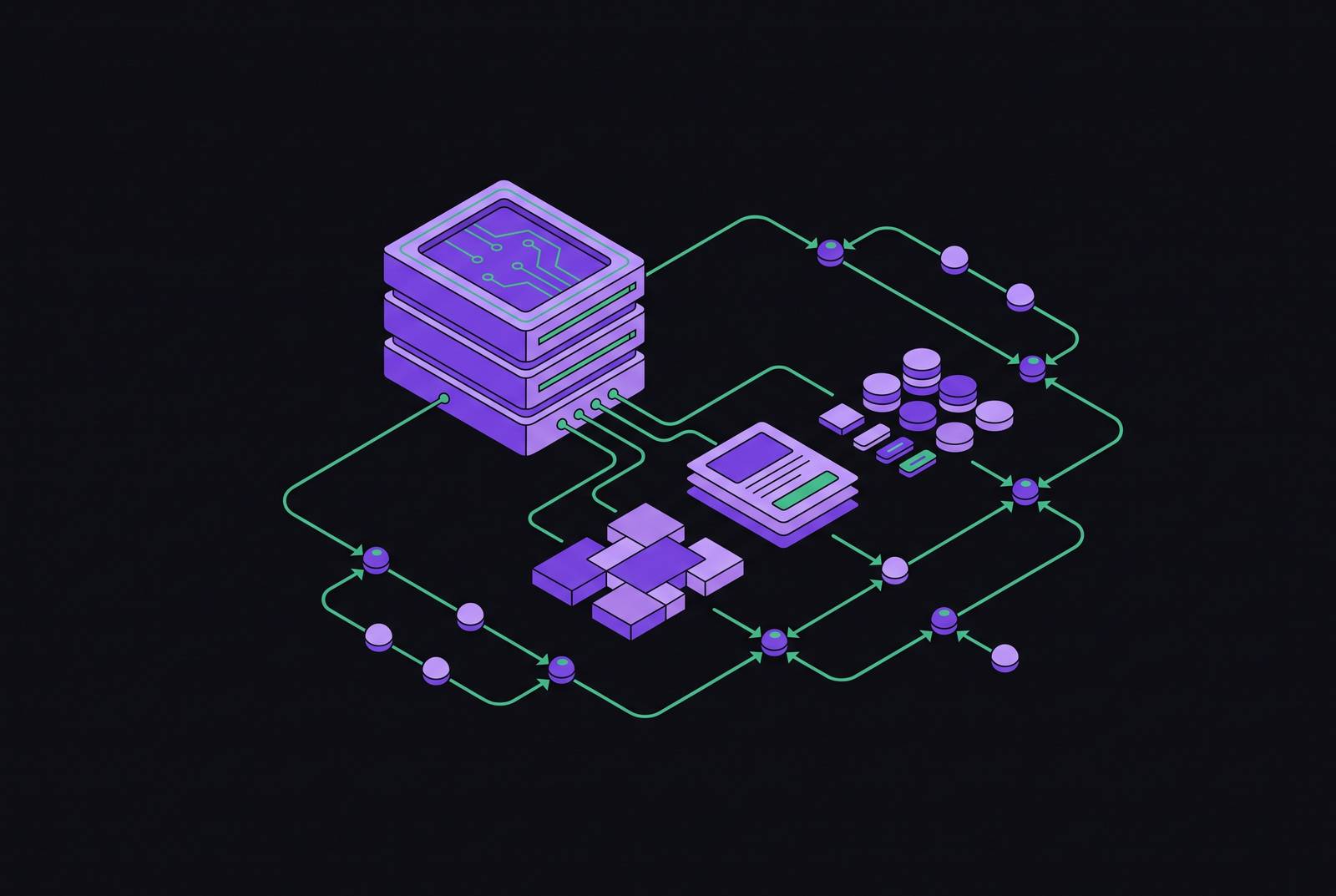
AI agents produce inconsistent brand output because nobody has given them a reliable way to look up what the brand actually requires at the moment they generate something. A model can write clean copy, lay out a clean interface, or pick a plausible color palette. What it cannot do, on its own, is know that this company's primary action color is a specific shade of blue reserved only for the main call to action, or that its headline voice never uses exclamation points. That information exists, but it typically lives in a PDF brand guideline, a set of Figma files, or the memory of whoever has been at the company longest. None of those are formats a model can query while it is generating a response.
One team member prompts an agent with a paragraph lifted from the brand PDF. Another pastes in a screenshot description. A third just writes "make it feel premium" and trusts the model to fill in the rest. Each of these produces output that is plausible on its own and inconsistent with the others, because each session is working from a different fragment of context, assembled by hand, and none of it is saved anywhere the next session can find it. The output looks like it belongs to the right product category. It does not look like it belongs to the brand.
Calling this a prompting problem misses what's actually happening. A prompt is a one-time instruction, typed into a chat window, gone the moment the session ends. No version history, no shared source, nothing for the next person or the next agent to build on. The failure here sits one level below the prompt: in the absence of a persistent, queryable place for brand decisions to live, so that every agent, every session, and every team member is drawing from the same facts. That is an infrastructure gap, and infrastructure gaps call for infrastructure fixes.
MCP and the Agent-to-Data Connection
The Model Context Protocol, MCP, is the infrastructure fix for exactly this kind of gap. Before MCP, connecting an AI model to an external system, a code host, a database, a design tool, meant building a custom integration, and rebuilding it again for every new AI application that needed the same access. Ten tools talking to ten data sources meant close to a hundred one-off integrations, each maintained separately, each breaking separately.
MCP replaces that with a single protocol implemented once on each side. A design tool or a code host builds an MCP server once. Any MCP-compatible agent or host can then query that server without anyone writing custom glue code for the connection. VS Code 1.102 and later, Claude Desktop, Cursor, and Windsurf are all compatible hosts today, so adopting MCP does not mean adopting new software so much as pointing existing software at a new kind of server.
That sounds like a plumbing detail: a stateless protocol scales horizontally without the usual headaches of session management, so a brand-context server built on MCP can serve many agents at once without the architecture getting harder as usage grows.
The other development is MCP Apps, which shipped in January 2026. MCP Apps let a tool return a rich UI component, not just a block of text or JSON, and have it render as a sandboxed iframe directly inside the user's chat. Figma, Canva, Amplitude, Asana, Box, Slack, Clay, Hex, and monday.com were among the launch partners. For a design system query, that means an agent can return an actual rendered preview of a component, not a wall of raw token values that a person then has to interpret.
What the GitHub MCP Server gives an agent access to
The GitHub MCP Server is one concrete implementation of this protocol, and it turns a Git repository into something an agent can read, search, and reason over directly. That matters for design systems specifically, because a modern design system usually lives in a Git repository already: tokens, component code, documentation, changelogs, pull requests, all version-controlled the same way application code is.
The server's capabilities cover browsing and querying repository contents, reading individual files, searching commits, analyzing code, managing issues and pull requests, and monitoring Actions workflows. These tools are grouped into named sets, context, repos, issues, pull_requests, users, actions, code_quality, code_security, copilot, dependabot, discussions, gists, git, governance, labels, notifications, orgs, projects, secret_protection, security_advisories, and stargazers among them, and each set can be turned on or off depending on what a given agent needs. The server moved to a v1.x numbering scheme in 2026 and ships on a weekly release cadence, with recent additions including a search_commits tool and smaller Project item payloads meant to cut down on token use. A --read-only flag is available too, which matters for any team that wants agents reading design system files without any risk of them writing to those files.
Put concretely, a single natural-language session with this server lets an agent fetch a token file, read the changelog explaining why a value changed, diff two versions of a component to see what moved, and check whether a pull request introducing a new color has already been reviewed and approved. That is the gap from the first section, closed directly: the brand decision is not sitting in a PDF or in someone's head, but in a file that the agent can open and read the moment it needs the answer.
Why storing design tokens in Git makes them agent-readable
A token file sitting in a Git repository is a live, versioned, queryable contract, and any agent connected through MCP can read that contract and act on it at the exact moment it is generating something. Every agent reading that file picks up the new standard on its next query, with no one needing to go back and re-edit a stack of saved prompts.
Naming the tokens well is part of what makes this work. A token called color.action.primary tells an agent what the value is for. A token called blue instead only tells the agent what color it is, and that name stops being accurate the moment the brand's primary action color changes to something that isn't blue. Semantic naming keeps the token accurate through a rebrand because it describes intent.
Most working design systems also use a three-tier hierarchy for this reason: global tokens set base values, alias tokens map those base values to a purpose, and component tokens apply aliases to a specific piece of UI. That structure lets one base definition support multiple products or sub-brands, and it gives an agent the resolution it needs to pick the right value for the right context.
None of this is a proprietary scheme invented for AI use. The W3C Design Tokens Community Group published the first stable version of the Design Tokens Specification in October 2025, with backing from Adobe, Amazon, Google, Baidu, Sony, Microsoft, Meta, Sketch, Salesforce, Shopify, and Figma, among others. A token file written to that specification can drive design tools and production platforms from a single shared source, which is exactly the property an agent-readable brand system depends on: one file, one format, read the same way everywhere.
How an agent-consumable brand runtime is structured in practice
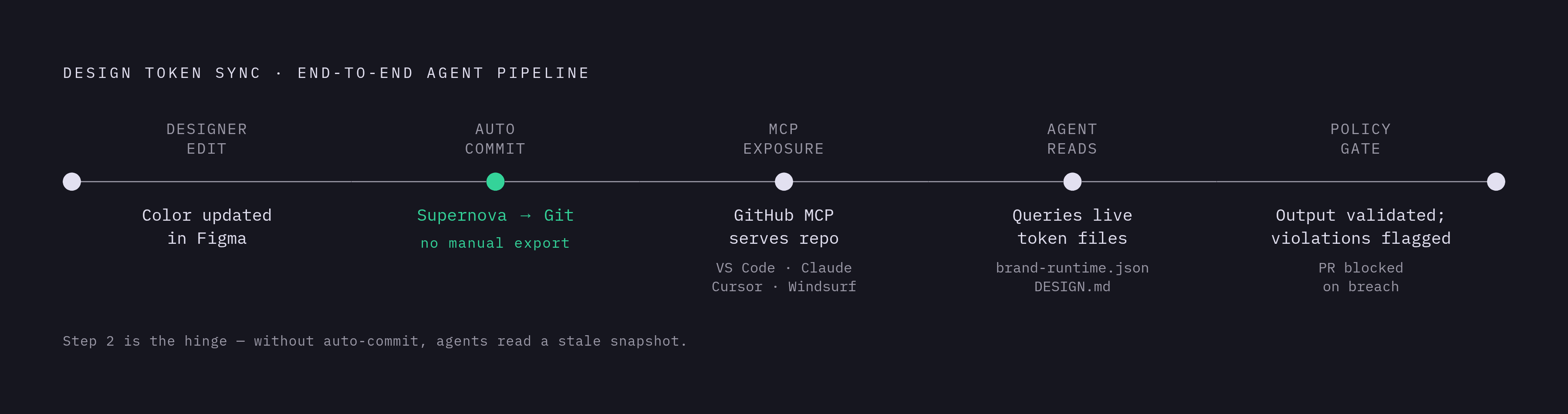
Getting tokens into Git is the foundation, but tokens alone tell an agent what the values are, not how to apply them or what to avoid. The structure now emerging in practice adds three files alongside the tokens. brand-runtime.json merges brand decisions from across sessions into one flat, fast-access document, keeping only values with medium or higher confidence. interaction-policy.json holds enforceable rules: visual anti-patterns to reject, voice constraints such as never-say word lists and AI-ism patterns to avoid, and policies on what claims the brand is allowed to make in copy. DESIGN.md is a design brief written in plain language, but written for a machine reader rather than a human one, portable enough to hand to any agent regardless of which tool it runs in.
Together these files support a simple workflow: fetch the tokens, transform them into context the agent can use, inject that context into the generation prompt, and validate what comes out against the policy file. Centralizing the material this way changes what a prompt has to contain. Instead of pasting in a large block of brand context every time, a prompt only needs to state what's different from the shared baseline, because the baseline itself is sitting in the repository where every agent can reach it.
The full loop becomes visible once a real change moves through the system. A designer updates a color value in Figma. A pipeline like Supernova, used by companies including SoFi, Hotmart, and TheFork, commits the updated token file to the Git repository automatically, with no manual export step. From that point, any agent querying the repository through the GitHub MCP Server sees the new value the next time it asks. The same server can also check a pull request that introduces a new component against the token hierarchy, flag anything that deviates as a comment on the PR, and block the merge if the rule violation is serious enough. That turns the design system from a document people are supposed to remember into an active constraint that catches deviations before they ship. When the next brand update lands, every connected agent inherits it on its next query, with no prompt rewritten and no one re-briefing the team.
The Southleft Design Systems MCP is a useful illustration of why this matters beyond simple convenience. A frontier model knows general design principles reasonably well from its training data, but it has no reliable way of knowing that a specific spec moved a field's location last week, or that a component library just reached a new release candidate. Training data goes stale the moment it's written, and an agent working from stale data produces output that looks confident and is wrong. A repository that the agent can query live is the fix for that specific failure.
Where this architecture hits real limits
This architecture works, but three things determine how safely it runs in production: the size of the tool set an agent has access to, how tightly access is scoped, and where tooling has to stop and governance has to pick up.
The remote GitHub MCP Server does not currently let an operator filter its toolset down to a subset. Access is all or nothing. Production guidance addresses this by applying method and tag filters at the deployment layer to keep each server's exposed tool count manageable, because language models make worse tool-selection decisions as the number of available tools grows. That's a documented constraint, and any team deploying this architecture at scale needs to plan around it.
Token budget is a related constraint. Diff payloads from large repositories can be large on their own, and every token spent reading a diff is a token not spent on generation. Structuring the brand runtime as a flat file like brand-runtime.json, rather than a deeply nested set of smaller files an agent has to traverse, keeps the cost of each query predictable.
There's a fair organizational objection to raise here too: brand consistency has always been a governance problem as much as a technical one, and no MCP server replaces design review, a well-run style guide, or cross-functional alignment between design and marketing. That's a correct objection as far as it goes. What this architecture does is enforce decisions that a team has already made and already committed to the repository. It does not make those decisions for them. Enterprise deployments typically add another layer on top: identity and access management through RBAC and OAuth, lifecycle and metadata management for each server, and real observability into what agents are querying and when. Red Hat's extensions to OpenShift AI are one visible example of this kind of governance layer being built out for MCP deployments generally.
Retrieval-augmented generation or better prompt engineering does not make a protocol layer unnecessary, because MCP delivers live, structured data retrieved at the moment of the query, not a static index built from a snapshot in time. A brand team that keeps its token file in Git and exposes it through MCP gets a current, authoritative answer every time an agent asks. A team relying on prompt engineering gets whatever the last person to touch the system prompt remembered to include, which is a weaker guarantee by definition.
Making a brand "agent-ready": what the design system repo needs to look like from day one
Building a design system that agents can actually use well means making a handful of structural choices early, rather than retrofitting them after the inconsistency has already shown up in production.
Name tokens semantically from the start. A name that describes intent, color.action.primary rather than a literal color name, keeps working correctly through a rebrand instead of becoming misleading the moment the underlying color changes.
Commit the three-file brand runtime, brand-runtime.json, interaction-policy.json, and DESIGN.md, to the same repository as the token files themselves. Keeping context and constraints in one place means an agent fetching one also has direct access to the other.
Build the token structure as a three-tier hierarchy, global, alias, and component, from the outset. That structure lets a single base definition support multiple products or sub-brands later without forcing an agent to resolve conflicts between values that were never designed to relate to each other.
Automate the pipeline from Figma to Git so the repository is never behind the actual design decisions. A periodic manual export defeats the purpose: the entire value of the GitHub MCP Server depends on the repository being the current source of truth, not a snapshot from whenever someone last remembered to update it.
Scope access by role. Generation agents should have read-only access. Agents responsible for enforcement can have PR-comment write access. No agent should have standing write access to files on the main branch.
Treat the brand runtime the way a software team treats API documentation: tag releases, keep a changelog, and update DESIGN.md every time a significant brand decision gets made. A design system that follows this discipline gives every connected agent a current, authoritative answer about what the brand requires, the same answer, every time, regardless of which tool or which team member is asking.