Subscribing Internal Agents to Brand State as a Live MCP Resource They Resolve at Request Time Not Session Start
Brand rules agents fetch per request stay current where session-start prompts go stale.
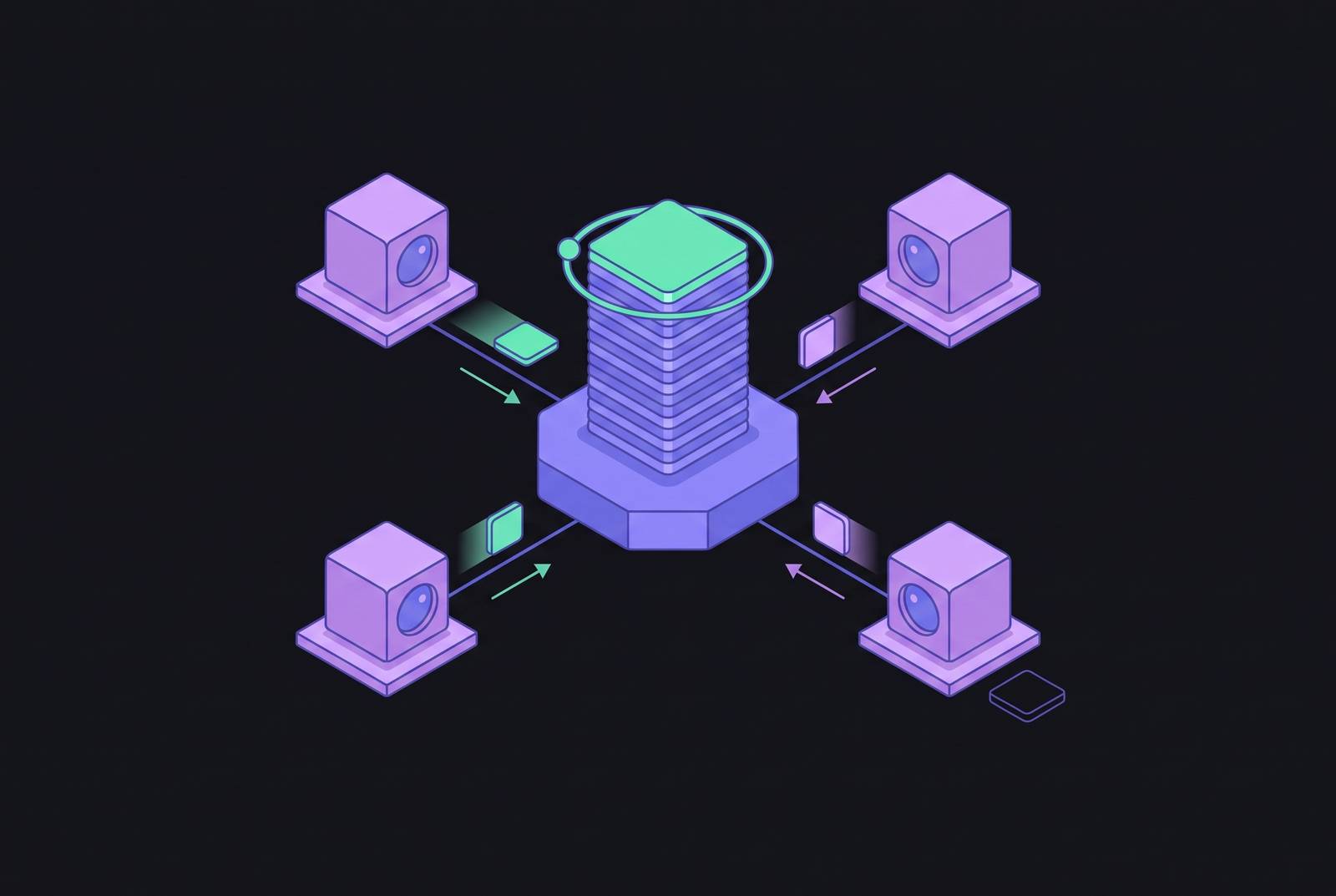
Giving internal agents accurate brand context requires a shared source of truth they resolve when each request begins. An MCP resource server provides that architecture, with stable URIs for bounded brand rules, subscriptions for updates, and caching matched to how often each rule changes.
Why brand context loaded at session start becomes a liability as agents scale
An agent completes a campaign brief using a tone-of-voice rule that was updated two days ago. The writing follows its instructions, but those instructions no longer match what the brand team has decided. Brand context loaded at session start becomes a stale copy as soon as its source changes, and the agent has no way to know.
Each agent may work from a different snapshot of the palette, approved terminology, or seasonal voice, so individually plausible outputs stop reading as one brand. Reconstructing the context manually in every prompt replaces stale snapshots with varying human interpretations. Both approaches keep the rules agents use apart from the system where those rules change, so neither works well as the number of agents and campaigns grows.
What MCP is and what it makes structurally possible for brand state
Anthropic’s Model Context Protocol announcement defines MCP as an open standard for secure, two-way connections between data sources and AI-powered tools. It has three roles: the host application, the client runtime inside that host, and the server that makes data or capabilities available. The server is the source-facing part of that connection. A shared protocol allows multiple agents and workflows to reach the same brand resources without a bespoke connector for each one.
MCP servers expose resources, tools, and prompts. Resources provide read-only structured data, while tools provide callable functions and prompts provide templated instructions. Brand rules fit the resource primitive directly. Voice guidelines, color tokens, approved terminology, and visual constraints are data an agent needs to read. That distinction gives brand state a durable location outside the instructions assembled for a particular conversation.
How the July 2026 spec revision made session-pinned brand state architecturally unsound
The official MCP changelog for the 2026-07-28 revision removes protocol-level sessions, the Mcp-Session-Id header, and the initialize handshake. Each request now carries its protocol version and client capabilities in _meta. The protocol is stateless under that revision. Brand context therefore cannot depend on an MCP session object persisting between requests, because that protocol-level storage assumption no longer holds.
The 2026 MCP roadmap identifies transport evolution and scalability as its top priority area, noting that stateful sessions conflict with load balancers and horizontal scaling. The architectural direction is away from transport-held state. For brand infrastructure, the consequence is a separation between the connection an agent uses and the identity of the rules it needs. Removing the protocol session does not remove the need for durable brand state.
The response is not to recreate transport sessions in application code. Instead, a brand resource has a stable URI that the agent resolves at request time, while the underlying rules remain independently maintained. A truly stable value can still be passed as a parameter. A rule that must remain available across calls and reflect changes needs a durable identity and a freshness policy, rather than an assumption that the original prompt remains correct.
How the new subscription model works for brand resource updates
The revised subscription model replaces resources/subscribe, resources/unsubscribe, and the HTTP GET endpoint with subscriptions/listen. Clients opt into particular changes through toolsListChanged, promptsListChanged, resourcesListChanged, or resourceSubscriptions. The server acknowledges which subscriptions it will honour. Subsequent notifications include a subscription ID, allowing the client to associate a change with its subscription.
Consider a seasonal tone shift published while an agent is writing campaign copy. The server sends notifications/resources/updated for the relevant resource, and the client re-reads that resource. The palette and terminology need not be reloaded. This separates initial delivery from ongoing currency, so a published change can reach a connected agent without someone rewriting its prompt. Subscriptions support freshness between requests, while request-time resolution supplies the rules needed for the task at hand.
That notification path has its own infrastructure requirements. Subscription streams remain open, unlike short tool calls, so quiet listeners can consume capacity intended for ordinary requests. A dedicated service or pool separates those workloads.
Structuring brand identity so agents can resolve it at request time
With one URI for the whole brand book, agents would have to fetch guidance they do not need each time they need a single rule. A bounded resource avoids that unnecessary context. With a tone resource, an active-palette resource, and an approved-terminology resource, the agent can resolve the rule set it needs for its current task.
The human-facing brand book remains the reference for nuance and judgment. The machine-readable layer is a separate artifact built from the same strategy work. Its audience has different needs. Brand Markdown can express strategy, voice, and visual identity, while structured JSON or YAML specifications, such as the MRBS format, can encode usage rules, hierarchies, and constraints that agents can validate. MCP resource URIs then provide live addresses, including brand://voice/tone-rules and brand://colors/palette-active.
Product names, audience labels, legal terms, reusable content formats, and tagged visual assets cannot remain contradictory across files if agents are expected to apply them reliably. Metadata also belongs in this translation work. Capability descriptions tell agents what a resource contains and influence when they select it and how they explain their actions, making those descriptions a brand decision as well as a technical label.
Who owns brand resource design when marketing and engineering share the same infrastructure
Engineering can expose a resource successfully without deciding whether its contents faithfully express brand strategy. Technical availability is not the same as brand approval. Leaving resource boundaries and descriptions entirely to infrastructure convenience risks turning implementation choices into unreviewed brand decisions.
A workable division gives the brand team ownership of resource contents and descriptions, while engineering owns the infrastructure that serves them. Both teams need a shared process for changes because a published update reaches connected agents. Versioning provides their common reference. A change log and rollback path make brand identity a managed artifact and give both teams a way to address divergence without relying on informal recollection.
A “Brand Guardian Agent” can evaluate drafts against brand guidelines only if it reads the same current source of truth used by the content agents. Shared infrastructure therefore connects the team that defines the rules, the agents that apply them, and the agents that check the resulting work.
The honest tradeoffs: when request-time resolution adds cost and when it does not
A fixed tagline or primary hex value does not benefit from repeated fresh retrieval if it has not changed, and session-start injection can be cheaper and equally accurate in that case. The objection is valid within that boundary. Active campaign themes, seasonal voice shifts, and recently updated legal terminology present a different freshness requirement.
A tiered TTL design preserves one resolution pattern without imposing one retrieval policy. Agents resolve resource URIs, while the serving layer uses long cache lifetimes for stable attributes and live reads or short TTLs for volatile ones. Freshness becomes an explicit property of each resource. That is more precise than treating every brand rule as either permanently fixed or in need of an uncached read.
Context cost also depends on what reaches the model. Connected tools describe their schemas, and a large tool set can consume context before the user sends a message. Reading a bounded rule set costs less than injecting a 60-page brand document, even when both have up-to-date guidance.
Dedicated subscription capacity must be planned before production, and a server containing proprietary positioning or campaign-sensitive rules needs authentication, least-privilege access, and monitoring. Live access is not free of responsibility. The practical synthesis is a tiered design in which volatility determines freshness and sensitivity determines access, rather than a binary choice between live retrieval and session-start injection.
Practical steps for wiring brand context as a live MCP resource
The first step is to audit and decompose the existing brand documentation. The inventory should cover voice and tone, color tokens, typography, approved terminology, visual constraints, and campaign-specific overrides. Each rule then receives a volatility classification. Stable rules change quarterly or less, moderate rules change from one campaign to the next, and volatile rules can change within a campaign cycle. This classification supplies the basis for cache lifetimes and subscription priority.
The second step is to translate those rules into separate machine-readable files. A tone-rules file, an active-palette file, and a terminology file create bounded units that agents can parse and apply without a person interpreting the brand book first. JSON, YAML, or explicitly labelled Markdown can serve that purpose. Each resource receives a stable URI, such as brand://voice/tone-rules, so its address remains the agent’s reference.
The third step is to expose those files as MCP resources. The server serves read-only brand data to multiple agents and workflows, rather than rebuilding context delivery for each application. Teams managing several brands have a deployment choice. They can use one server per brand or one server with brand-namespaced resource paths. Where a platform provides versioned brand context and agent access over MCP or a REST API for product integrations, it can remove the need to build and maintain that serving infrastructure from scratch.
The fourth step is to configure caching from the volatility classifications. Resources that rarely change, including primary brand colors and fixed taglines, can use long TTLs, while active campaign palettes and seasonal tone rules need fresh responses or short TTLs. The URI remains the same point of access. This policy contains retrieval latency without assigning the same freshness tolerance to rules that change at different rates.
The fifth step is to subscribe agents to the volatile resources they need. A subscriptions/listen channel lets the server send notifications/resources/updated when the brand team publishes a change, after which the agent re-reads the affected resource. Subscription streams need a service or pool of their own. Keeping them off the ordinary request path means notification listeners do not have to compete with routine resource access.
The sixth step is to secure the server and define resource access. Authentication belongs at the server level, and least-privilege permissions should reflect each agent’s work. A campaign-copy agent needs voice and palette resources and has no need for typography specifications for the engineering design system. Access logging gives the brand team a record of which agents read which rules and when. That record supports oversight without treating every connected agent as entitled to every brand resource.
The final step is to review generated work before it ships. The agent can check its output against the same live brand source it used to produce the draft, with evidence for each check making the process auditable. In the opening failure case, that review compares the campaign brief with the current tone rule rather than approving it against the stale instructions that caused the inconsistency.