Exposing Brand Asset APIs as MCP Tools
Structured, versioned brand data lets agents apply your identity correctly.
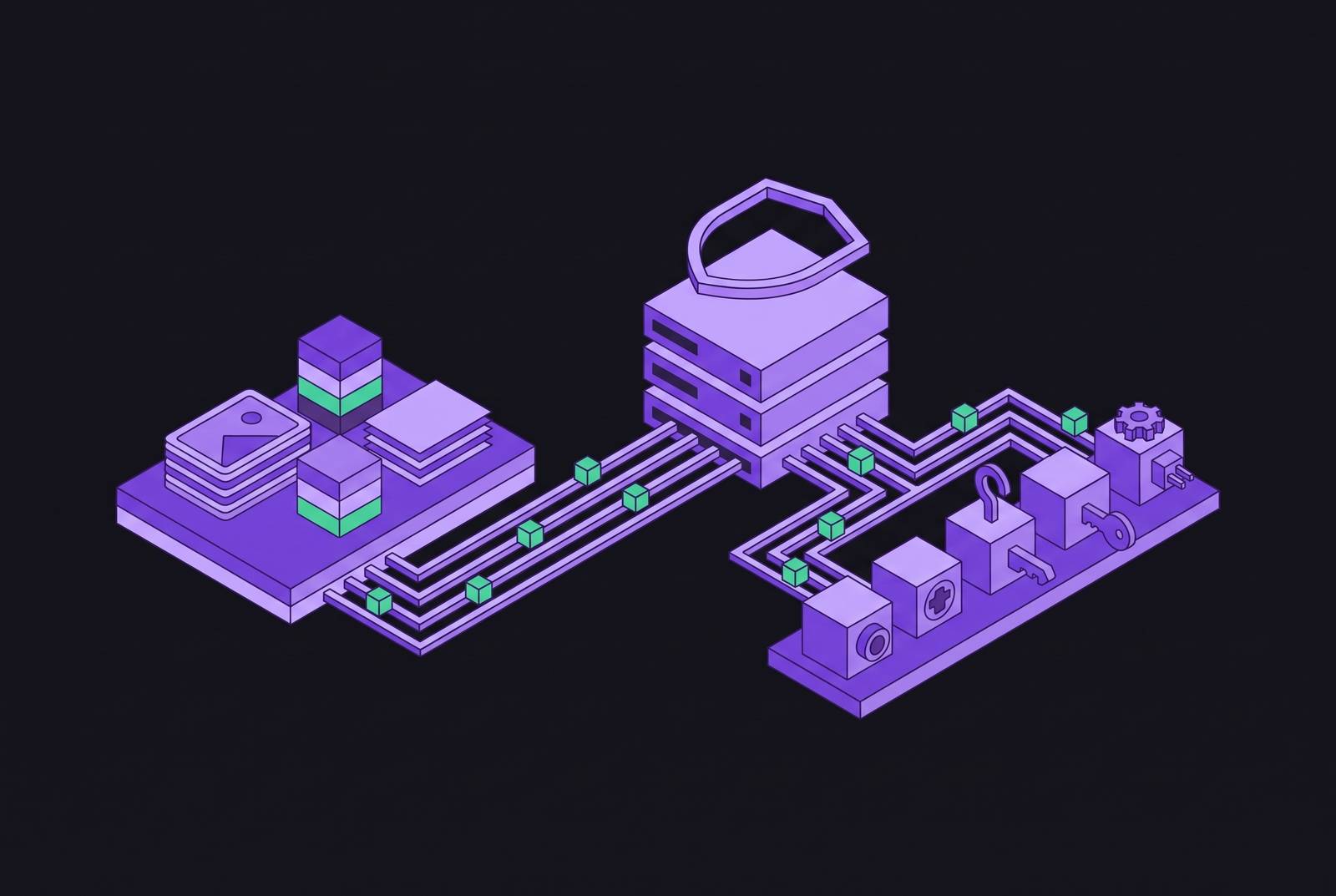
Exposing brand asset APIs as MCP tools turns brand identity into infrastructure that agents can use at task time. The work is structuring logos, color tokens, type rules, and voice guidance so that compatible agents can discover, apply, and validate approved brand context from one governed, versioned source.
What MCP actually is and what it changes for brand assets
Anthropic released the Model Context Protocol as an open standard in November 2024. MCP sets out how AI applications find and use external data and capabilities. Its three primitives have direct brand applications. Resources give agents read-only context, such as logo metadata and voice guidelines. Tools perform functions, such as fetching an approved logo variant, while prompts provide reusable instructions for representing the brand in a particular task.
MCP wraps existing APIs. That reduces an N×M integration problem to N+M, because applications and data providers use the same specification to connect instead of each needing their own custom integrations. By mid-2025, OpenAI, Google DeepMind, Microsoft, and Cloudflare had adopted it natively. The Linux Foundation later took over governance, and working groups were formally set up under SEP-1302. The protocol therefore provides a multi-stakeholder foundation for brand access.
Why AI agents cannot find brands that haven't structured their identity for machine consumption
The cosmetics brand example exposes an ownership gap. Its CTO treated MCP as an integration ticket, while its CMO had never heard of it. No one was in charge of linking technical access to how agents represent the brand. That division leaves a basic question unanswered, namely whether an agent can retrieve the approved information it needs to represent the brand accurately.
A PDF or shared-drive slide deck does not provide a queryable brand interface. Agents that look for structured data, API endpoints, and semantic tags cannot use those materials the way people use a brand book. When agent workflows skip non-MCP catalogs or return low-confidence results, brands with accessible integrations can receive the citation instead. The quality of the visual presentation does not make those materials queryable by agents.
Traditional SEO and feed optimization do not cover this interface. The competitive concern is “share of model,” meaning how consistently and accurately a brand appears when agents query leading language models. Technical teams can expose an endpoint, but the information behind it still needs approved meanings, usage rules, and a brand owner.
What brand identity needs to look like before it can be exposed as MCP tools
A 60-page brand PDF has no queryable field for a secondary accent color at 40 percent opacity. Before MCP can expose that answer, the underlying identity needs structure. Design tokens express color values, typography scales, spacing units, and logo lockups as JSON or YAML. Voice schemas set out the approved vocabulary, banned phrases, reading-level targets, and sentiment ranges. Compliance flags make regulated claims and regional restrictions machine-checkable, while asset metadata records usage rights, expiration dates, and approved channels.
These elements need API-accessible endpoints. Emerging specifications provide vocabulary for organizing the context. The brand.md specification covers strategy, voice, and visual identity, with optional governance, while SKILL.md packages reusable instructions for compatible agents. Google Labs’ DESIGN.md is an open-source, Apache 2.0 draft specification that brings together design tokens and plain-text context for AI coding agents. AGENTS.md tells coding agents how to work within a codebase.
These formats serve distinct purposes within machine-readable context. Their shared value is reducing the interpretation required to apply a rule. “A warm, optimistic orange” expresses an intention, but a color token supplies a value that agents and design tools can reference directly. The same distinction applies to type, spacing, and voice. Precise inputs constrain variation before generation begins.
How to map brand assets to MCP primitives: resources, tools, and prompts
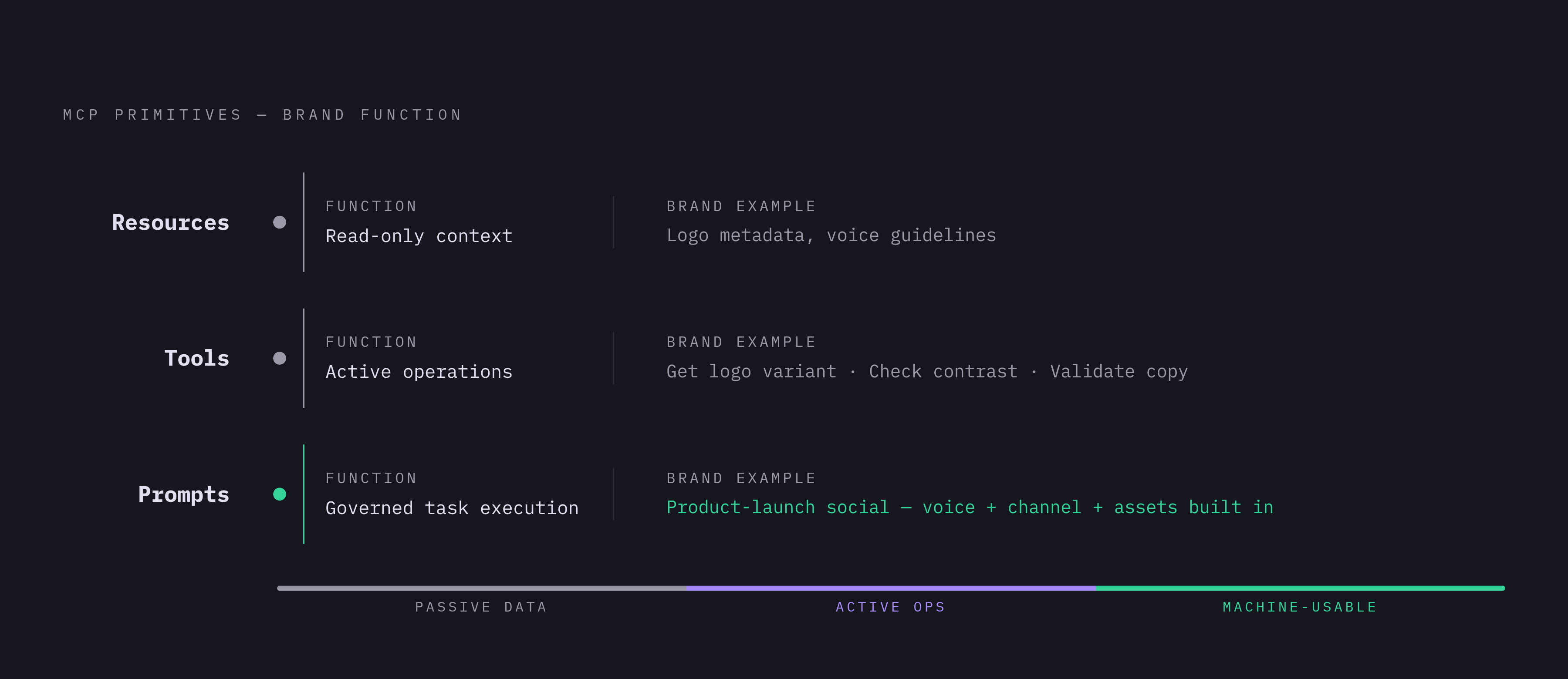
For implementation, the mapping starts with how an agent will use each item. Resources hold the approved facts that an agent reads. Color resources include hex, RGB, and HSL values with named roles and usage restrictions. Typography resources contain approved typefaces, weights, scale ratios, line-height targets, and fallback stacks. Logo resources combine asset URLs with format, minimum size, background requirements, exclusion zones, and expiration dates, while voice schemas and campaign history supply language and messaging context.
Tools expose actions performed with those facts. “Get logo variant for dark background” returns an asset suited to a surface, while “Check color contrast compliance” validates a foreground and background pair against accessibility and brand rules. “Retrieve tone rules for channel” selects the relevant voice schema. “Validate copy against brand flags” returns pass/fail with evidence. These names describe a specific operation and the context it needs, rather than leaving the agent to infer what a generic asset function does.
Prompts set out the task that will use those capabilities. A product-launch social prompt can specify brand voice, channel, and approved assets, with channel rules built into the template. Capability descriptions also influence selection and how agents explain their outputs, making their wording a brand decision. Policies then restrict which agent roles can invoke each tool. Compliance flags belong at that tool boundary as well as in a review after the work is produced.
What a live brand MCP server looks like: Frontify's implementation
Frontify announced its MCP server in May 2026, connecting its brand portal to compatible tools including Claude, ChatGPT, Cursor, and Figma. Agents can access brand context within the application where work happens. The server exposes logos, visual systems, templates, tone-of-voice guidance, messaging frameworks, campaign history, and localization information. Its 52 predefined skills cover asset discovery, brand guideline enforcement, and template generation from natural language prompts. Access follows each user’s existing Frontify permissions, including restrictions tied to role, region, or permission level.
The implementation brings three design principles into focus. It is live, so agents query current brand state. It is structured rather than narrative, using tokens, named layouts, and asset URLs with metadata. It is also governed and versioned, limiting exposure to approved assets and propagating changes through versioned updates.
Figma offers a related example for a design-system, though its scope differs from that of a brand portal. Its MCP server became generally available at Schema 2025. Coding agents can look up actual component names, spacing tokens, and accessibility properties within developer workflows. The common pattern is access to authoritative design context. The distinction is the scope of that context and the work it supports.
Six decisions that shape a brand MCP server before the first line of code
The first decision is what to expose initially. Brand constants, including logo, color, type, and voice rules, need to be stable before agents receive responsibility for creative variables. Starting with campaign concepts or formats without those constants leaves the server distributing context that lacks a dependable foundation.
The second decision concerns the authentication model. Open access and user-authenticated, role-scoped access set different limits on who can use the same assets. Flat access leaves no distinction between what different users or agents should receive. Frontify’s permissions model demonstrates the production pattern of restricting retrieval to the context a user is entitled to access.
The third decision is how frequently data updates. Campaign imagery, seasonal palettes, and regional compliance rules need to be up to date. Real-time access and batched updates make different promises about freshness. Versioning must also allow connected agents to pick up changes rather than preserve isolated copies of their last briefing.
The fourth decision sets the rules for error handling and fallback behavior. Unavailable or ambiguous brand data leaves an agent without a reliable instruction. An undefined fallback invites improvisation and off-brand output. The server should specify a safe default.
The fifth decision is how MCP fits existing infrastructure. The starting inventory distinguishes queryable brand data from information still trapped in PDFs or DAM exports. HubSpot made its remote MCP server generally available to all HubSpot accounts on April 13, 2026, with read and write access. That example shows how existing SaaS infrastructure can support MCP without rebuilding the underlying data systems.
The sixth decision is what usage analytics will capture. Tracking which agents accessed which assets, when, and in what context makes brand use auditable. Useful signals include how often AI cites the brand, which prompts and tasks lead to the use of which assets, and AI crawler activity on brand endpoints.
Security and governance risks that brand MCP servers must address before going live
Standardized discovery creates an attack surface as well as an access route. Tool poisoning is particularly relevant to brand representation. An attacker who injects instructions into server metadata can redirect how agents describe or apply a brand without changing the approved identity itself. Along with data theft, the risks include agents representing the brand without approval across their workflows. Governance must be part of the server design.
A production server needs clear permission scopes for every tool, with no broad grants of access. Every access request needs logging to record which agent touched which brand data and when. Active agent connections also require periodic audits. Tool calls that involve asset writes or compliance-sensitive outputs should not be approved automatically. These controls make access reviewable at the points where agents can retrieve, change, or apply brand information.
The protocol’s history reinforces that responsibility for server operators. The initial 2024-11-05 version lacked standardized OAuth support and an audit trail specification, and its authentication relied on static secrets. OAuth 2.1 arrived in March 2025, while the 2026 roadmap identified security gaps as priorities. Standardization alone does not settle whether data should move. For servers enabling AI-generated creative, legal requirements also enter the policy design, including disclosure requirements under New York’s synthetic performer rule, set to take effect June 9, 2026.
How the multi-agent and multi-brand case changes the MCP design requirements
For agencies and multi-brand operators, concurrent work changes the architecture. Earlier workflows had a person between production steps who put outputs together, resolved differences, and applied standards. Multi-agent workflows remove that handoff, so consistency must be enforced through shared context and access rules. Isolated MCP configurations reproduce the weaknesses of isolated prompts. Each agent can otherwise work from a different understanding of the same brand.
The useful separation is between constants and creative variables. Logos, colors, visual language, tone, recurring characters, and product identity remain controlled, reusable inputs. Concept, shot, camera angle, format, script, and platform can change per campaign without redefining those inputs. MCP servers per brand, built on shared protocol infrastructure, keep Client A’s identity available without reconstructing it for each asset. This gives creative experimentation a stable reference point.
MCP governs tool access. The companion A2A protocol addresses agent-to-agent orchestration, marking the boundary between retrieving brand context and coordinating a workflow. Typeface illustrates the value of a centralized brand intelligence layer, bringing voice, visuals, rules, audience data, and approved assets into shared context for different agent types. A drafting agent and an imagery agent need different inputs from that same foundation. The decisive versioning test is whether every agent working on a brand receives changed guidelines automatically or needs a manual re-briefing.
Keeping brand MCP servers current as the brand evolves
Stale brand data can masquerade as current authority. A server exposing last quarter’s identity may confidently return an outdated logo URL or superseded color token across concurrent tasks. A logo refresh, voice update, or compliance change therefore needs to propagate as a versioned update. Concise, structured brand documents support that discipline without separate briefings for every agent. Live access means pulling assets from their authoritative source at query time.
Fresh retrieval still needs validation before publication or delivery. Checking AI-generated work against the same structured rules that supplied its context brings the process full circle. Evidence for each check connects the approved brief to the resulting output. Brand context stays in one versioned source, and the review checks whether agents used it correctly.