MCP Resource Endpoints vs Tool Calls for Brand Context
Brand identity belongs in Resources and brand actions in Tools.

The choice between MCP Resource endpoints and Tool calls for brand context sets who decides whether an agent gets the information it needs. Brand identity belongs in Resources because the host can supply it before the model acts. Tools belong to the actions that consume that identity. A reliable setup keeps those roles separate, gives agents one versioned source to share, and uses subscriptions to keep it up to date.
What MCP primitives are and how the protocol assigns control over each one
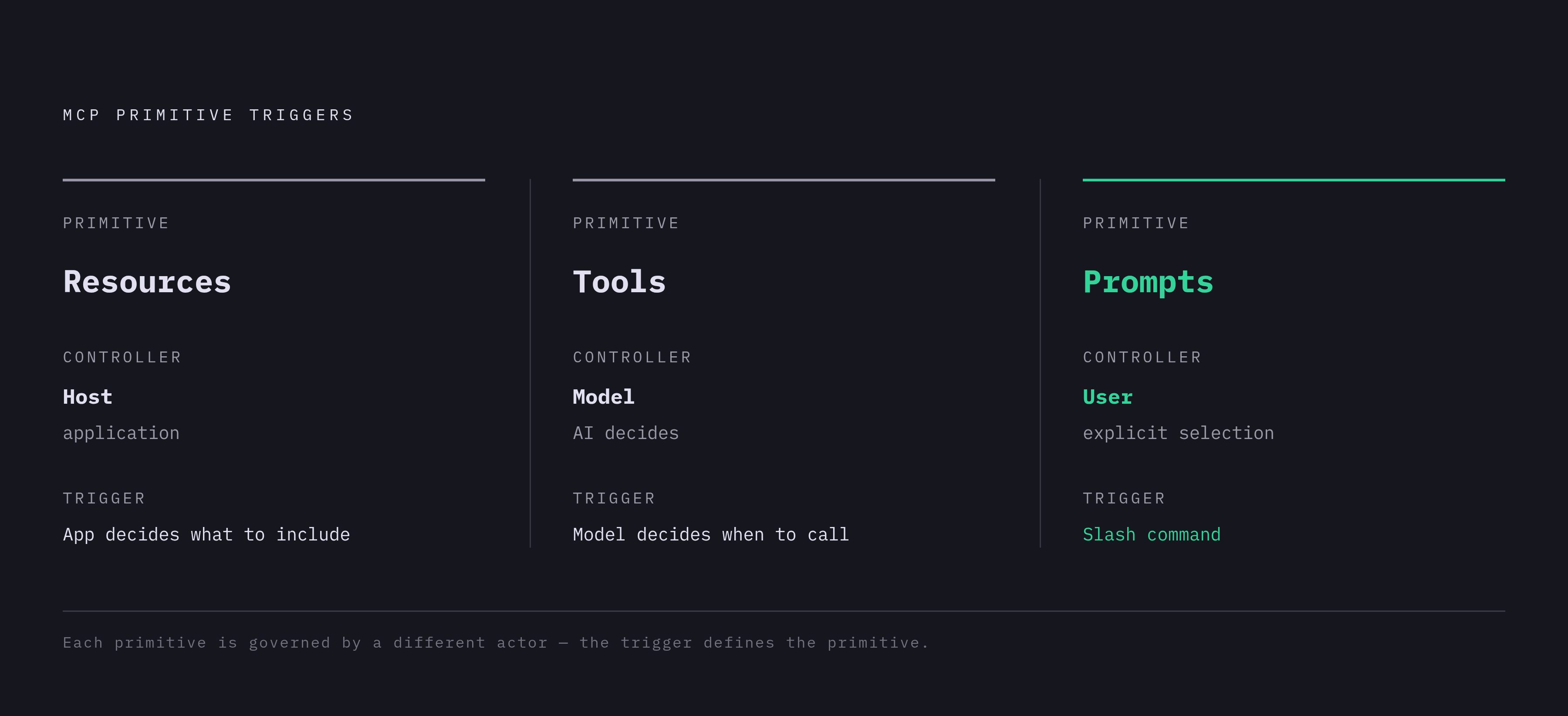
The MCP specification assigns a different controller to each of its three primitives. Resources are application-driven, so the host decides what to include. Tools are model-controlled, so the model decides when to call them. Prompts are user-controlled message templates selected explicitly, such as through a slash command. The trigger is the essential distinction between them.
Resources expose named, addressable, read-only data under a URI. The host can list or search those resources, let a user pin them, or include them by heuristic without requiring a model decision. Tools instead expose operations that the model invokes through tools/call, fitting work that is dynamic, parameterized, or has side effects. A Tool result can also return a resource_link pointing to a larger resource that the client may read. That hybrid still starts with a model-controlled call, and the linked resource is not guaranteed to appear in resources/list.
Why the Resource primitive maps structurally onto brand identity data
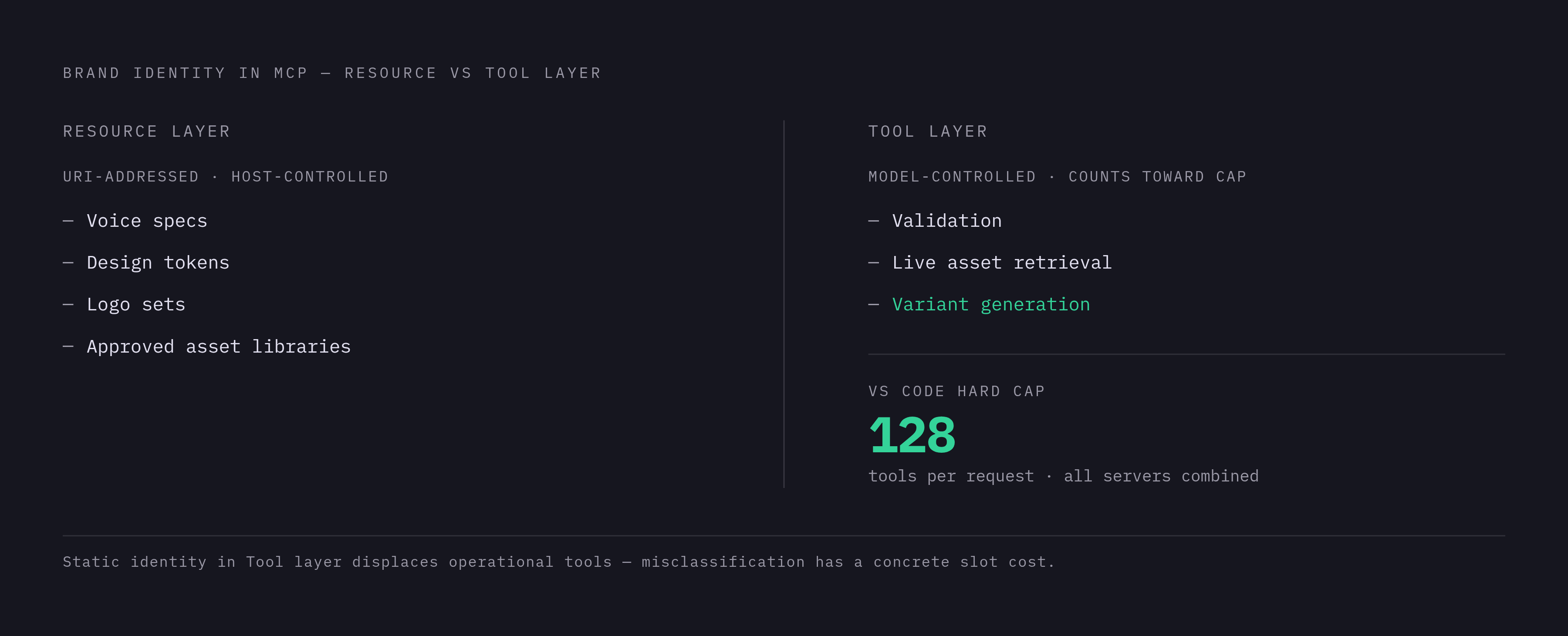
Brand guidelines, voice specifications, design tokens, and approved asset libraries fit the Resource profile. They have stable identities and can be addressed individually. A voice guide remains a voice guide whether an agent uses it to draft an email or prepare an ad. Its URI gives the host an address for that reference, while the read-only contract reflects the fact that consulting a guideline does not change it. The brand itself can still change when access is read-only.
A brand.md file makes this fit concrete. It is a structured Markdown file holding brand strategy, voice, and visual rules in a form a language model can ingest without ambiguity. Exposing it as a Resource allows the host to pin that identity into context through configuration or heuristics. The model does not have to remember to request the rules before producing work governed by them.
That distinction becomes more important when agents replace the human translator between a guideline and its application. Documentation written for people can depend on interpretation that an automated workflow instead needs in structured data. Reliable access is part of that requirement. A Tool for validating a draft or fetching a live campaign asset performs work whose result depends on its inputs. A Resource gives that work a reference to follow.
What the subscription mechanism adds: keeping brand context current without polling
Resource subscriptions extend host-controlled access into host-controlled freshness. The MCP specification describes a client opening subscriptions/listen with the resourceSubscriptions capability. When a resource changes, the server sends notifications/resources/updated, and the client reads it again. One subscription replaces a repeated polling loop. For brand infrastructure, checking for changes does not depend on the model deciding to invoke a Tool.
A campaign palette refresh, voice update, or new sub-brand can thus reach connected agents without anyone having to reconfigure them, as long as their hosts subscribe and reread the changed resources. The notification prompts the read that brings the updated version into use. Separately, listChanged supports notifications/resources/list_changed when the available set changes, such as when a brand adds an asset library or retires a guideline document. Changes to content and changes to the catalog are distinct events.
Resource annotations give the host more signals for what to keep and how to order it. The MCP schema included Resource.annotations from 2024-11-05, with audience and priority arriving in 2025-03-26 and lastModified in 2025-06-18. Those signals support selection as well as freshness. In particular, lastModified lets a host deprioritize stale brand assets automatically. Subscriptions and metadata together support a living identity system rather than a document copied into a session and forgotten.
The context-window cost of using Tools where Resources belong
Using Tool definitions for brand context adds overhead before the agent starts its task. With multiple servers, those definitions can take up much of the available context. The cost compounds as the tool catalog grows. Resources let the host choose and include the documents it needs without model-controlled Tool calls. The documents still take up context, but the model does not have to choose an operation to get each reference.
VS Code enforces a hard cap of 128 tools per request across all servers. Brand references exposed as Tools compete with the operations an agent actually needs to perform. Even a few pages represented this way count against the tool limit and introduce the possibility that the model will not call them. Curating a small set of high-signal Tools per agent and using Tool Search for the long tail addresses catalog growth, while moving static identity into Resources keeps reference material out of that catalog.
Where Tools are the right choice: the brand actions that consume context
Brand validation is a clear example of a proper Tool. It accepts a draft, applies brand rules, and returns a verdict with evidence tied to that specific input. The result changes with the submitted work. Live asset retrieval from a DAM also fits because the model chooses a parameterized query based on the task, and the returned asset varies accordingly. Generating an on-brand image or copy variant goes further by creating a new artifact.
Amazon Ads’ MCP server illustrates the action side of this distinction. It can bundle campaign creation, ad group configuration, and ad building into a single Tool call invoked by an agent in one prompt. These are sequential operations with side effects. In a brand server, they can consume the same Resources already supplied to the agent, keeping the rules separate from the operations that apply them.
What happens when brand context is siloed across agents rather than shared through one endpoint
When each agent maintains its own brand context, the system accumulates isolated copies. An email agent may hold a voice guide from before a tone update while an ad agent holds the new version. Both can pass their local checks and still diverge across the campaign. The guidelines need not contradict one another. The failure arises because the agents are working from different states of the brand.
That fragmentation also obstructs diagnosis when finished work fails review. Without shared lineage or an audit trail, the team cannot trace which version of the context informed a particular output. Correcting the output does not resolve the underlying drift. Assets with poor structure make this harder because even an up-to-date copy may lack the information an agent needs to interpret it. A file named campaign_image_04_final.jpg says little about the permissions, relationships, taxonomy, or usage rules needed for machine-readable brand context.
Jasper IQ keeps brand context shared across a team by embedding brand voice, style guides, audience profiles, and product knowledge into every output automatically. Jasper’s MCP server also makes that context available to other AI tools. Typeface’s Brand Agent approaches the issue through review. It checks images and copy against a Brand Kit before publishing and flags deviations in tone, terminology, and visual treatment. These examples address different parts of the workflow, but both use a common reference rather than treating each agent’s local copy as authoritative.
How a brand MCP server should be structured: one source, versioned, shared across agents and products
A brand MCP server should expose voice specifications, design tokens, logo sets, and approved asset libraries as named, URI-addressed Resources. Hosts can then pin the appropriate references into connected agents’ context without model-controlled invocation. Versioning supplies the basis for consistent change. When the server updates a Resource and notifies subscribers, agents working from it receive the new version on the next read. The versioned source replaces manual reconfiguration of independent agent copies.
The Tool layer should contain validation, live asset retrieval, and variant generation. These operations consume the brand Resources while accepting the parameters required by the task. The division remains clear within one server. For agencies or other multi-brand teams, separate Resource namespaces allow sessions to be scoped to the right identity without cross-contamination. Jasper’s support for multiple brand voices for different audiences, sub-brands, or regions illustrates the practical need to preserve those boundaries.
MCP compatibility makes the shared server usable across Claude, ChatGPT, Cursor, Codex, and other MCP-compatible agents without rebuilding the integration for each product. The common endpoint supports consistency across work such as images, pages, and decks. Streamable HTTP is the current specification’s preferred transport for remote servers, and OAuth 2.1 is the recommended authentication scheme.
Finished work should be checked against the brand Resource with evidence for each check before it ships. A validation Tool can perform that review using the same brand context supplied to the creating agent. Creation and evaluation then share an explicit reference. This closes the governance loop without asking a separate review process to reconstruct the rules that should have governed the work.
Practical decisions for teams building a brand MCP server today
For teams implementing this architecture, the first decision is what an agent must know before acting. Identify the voice specifications, design tokens, approved color palettes, logo sets, and usage rules that belong in the Resource layer. Give each of those references its own URI-addressed identity. Structure the content before exposing it, using brand.md, JSON design tokens, and richly tagged assets rather than relying on an unstructured PDF to supply usable rules. Addressability alone does not make a document clear to a model.
Enable Resource subscriptions for a changing brand so that hosts can reread updated references rather than depending on repeated model-controlled checks. Keep each brand in a separate namespace where multiple identities share the infrastructure. Scope agent sessions to the appropriate brand. For remote deployment, use Streamable HTTP and the recommended OAuth 2.1 authentication scheme to support access to that shared server.
Finally, keep Tools for actions such as validation, asset retrieval, and generation. Exposing identity as a Tool merely because a callable interface appears more dynamic gives the model more to choose from while leaving the ease of getting the rules unchanged. Build the validation step into the workflow from the start, checking finished output against the same Resource used during creation and returning evidence for each check. The host should provide the brand context, while the model chooses the operations needed to complete the task.