Cloudflare MCP Server for Edge-Deployed Brand APIs
Stateless edge APIs let AI agents reliably query brand guidelines instead of recreating them.
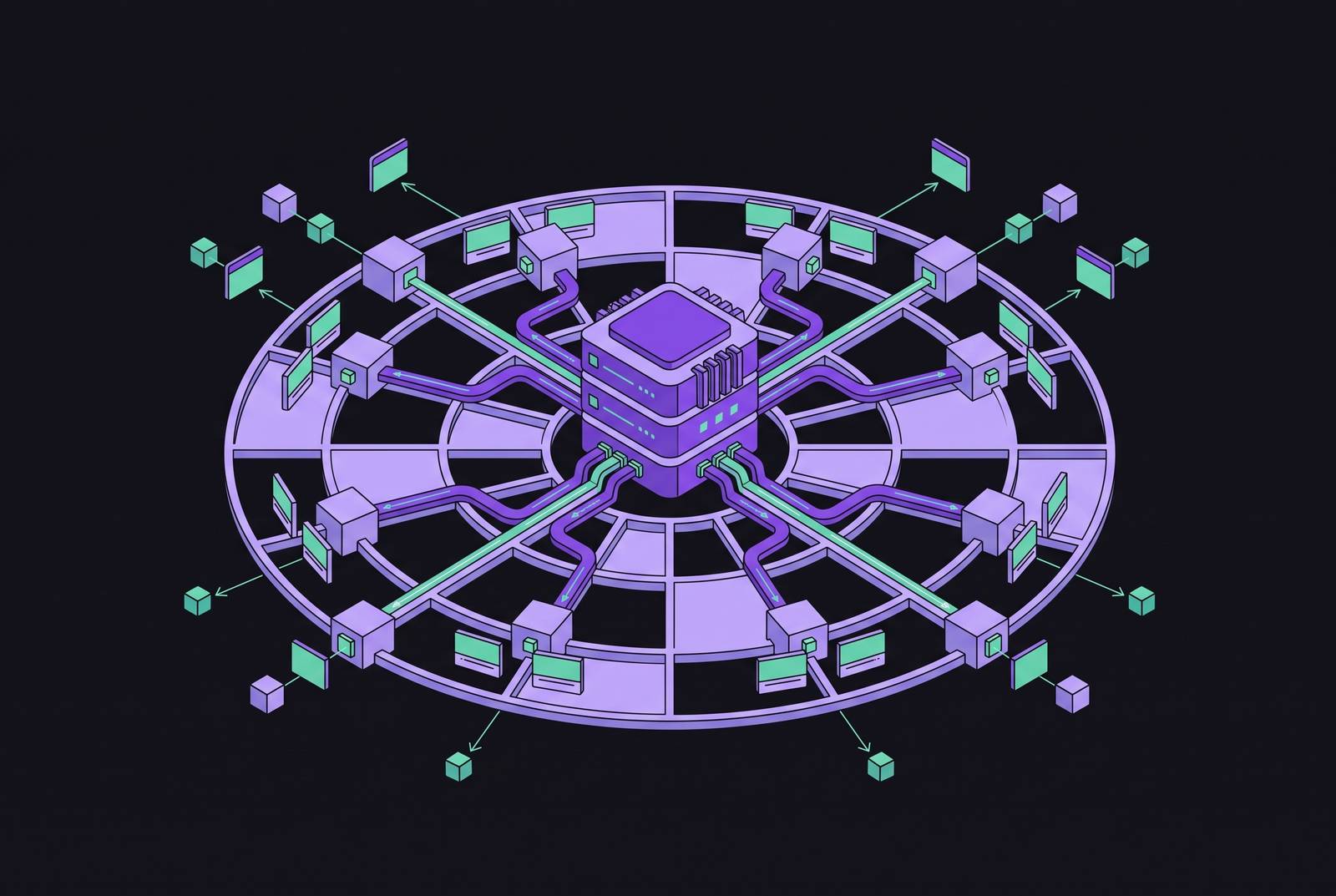
A live, MCP-accessible Brand API solves a specific failure mode: AI agents that generate off-brand work because brand guidelines exist as PDFs and slide decks no machine can query. Cloudflare Workers, running at the edge and speaking the Model Context Protocol, give teams a concrete way to host that API: stateless, globally distributed, and reachable by any MCP-compatible agent, from Claude Code to Cursor to custom tools built in-house. The rest of this piece lays out why that architecture matters and how to build on it.
Why a live brand API changes what AI agents can reliably do
Pasting brand guidelines into a prompt works for exactly one session. The moment a new conversation starts, with a different tool, a different team member, or even the same person a week later, that context is gone, and whoever is running the agent has to reconstruct it from memory or go dig up the deck again. This is a structural reason why AI-generated brand work drifts, and it compounds every time someone skips the reconstruction step or does it imperfectly.
Brand guidelines have a deeper problem: no one wrote them for machines to read. Converting human-readable guidelines into structured, labeled, retrievable rules is the actual problem. Brand infrastructure platforms like Rainbrand solve it by ingesting existing assets and transforming them into versioned, labeled Brand Skills that agents can query by type.
By the time someone flags a mismatched color or a voice that reads wrong, several more outputs have likely gone out the door with the same problem. It's a predictable failure mode of any system that treats brand context as something to be re-explained rather than something to be looked up.
The fix is infrastructure: a live, queryable Brand API that every agent, regardless of which tool, which session, or which person is driving, pulls from the same versioned source of truth. The Model Context Protocol defines how agents connect to external tools and data sources, so brand context becomes something an agent retrieves on demand. MCP itself is only a delivery mechanism, though. The protocol moves data; it doesn't organize it. A team still needs to build and host the structured source that MCP reaches into, and that means standing up an actual API endpoint that any MCP-compatible agent can find and query.
Cloudflare's edge infrastructure for hosting an MCP server
Cloudflare's MCP servers run as Workers on a globally distributed edge network. For a Brand API that agents might query from anywhere, that geographic distribution reduces the latency a human would otherwise notice as a lag before the agent responds.
Cloudflare's MCP server documentation confirms support for the MCP 2026-07-28 Specification and stateless requests from 2025 Streamable HTTP clients, which together form the protocol baseline that both current and legacy clients need in order to interoperate. The stateless design is a meaningful simplification: every request carries its own version and client capabilities, so there's no initial handshake to negotiate and no persistent HTTP session for the server to track. That removes an entire category of infrastructure complexity, and with it the failure modes that come with managing session state across a distributed system.
The endpoint surface stays simple as a result. The Streamable HTTP endpoint at /mcp is the recommended connection point for new clients. Historical /sse URLs still work, but they're aliases pointing to that same Streamable HTTP handler rather than the deprecated SSE transport itself, so any client still forcing SSE needs to migrate.
Authentication is part of the architecture from the start. Cloudflare's remote MCP server model supports OAuth, so users sign in and grant scoped permissions, with the MCP server acting as both an OAuth client to an upstream identity provider and an OAuth provider to the MCP clients connecting to it. Cloudflare also offers MCP server portals, a zero-trust gateway that sits in front of any MCP server, covered in fuller detail later in this piece; access control was designed into this infrastructure from the start, not retrofitted.
The token-efficiency problem that makes a naive Brand API unworkable at scale
Standing up an MCP endpoint is necessary but not sufficient. Whether an agent can actually use that endpoint depends on how it exposes brand data. The naive approach, turning every brand asset, color, rule, and guideline into its own separate MCP tool, breaks down fast: Cloudflare's own documentation shows that an MCP server exposing every API endpoint as a native tool would consume more tokens than the entire context window of most foundation models. When that happens, the agent doesn't fail loudly. It simply runs out of room to reason about the actual task because the available context is already full of tool definitions it hasn't even used yet.
Cloudflare's answer is a search-then-execute pattern. The agent first calls search() to query by product area, path, or metadata; the full specification never enters the model's context. Only after narrowing down what's relevant does the agent call execute(), which runs code handling pagination, conditional logic, and chained calls in a single cycle, cutting down the back-and-forth that would otherwise burn tokens on round trips. That generated code runs inside a Dynamic Worker sandbox with no native filesystem, no environment variables unless the parent Worker explicitly injects them, and outbound requests blocked unless globalOutbound is explicitly configured. The agent gets the autonomy it needs to complete a task without gaining access to infrastructure it has no business touching.
For a Brand API, this sets a real design constraint, not just a transport detail. Brand context should be structured so an agent can search for what it needs, a specific hex value, a single voice rule, one approved asset, instead of being handed the entire brand document and asked to find the relevant part itself. You make that schema decision before a single line of server code gets written, and it decides whether the eventual API holds up at real scale or quietly exhausts every agent that tries to use it.
Structuring brand context for efficient MCP serving
The schema has to start with semantic labels, not flat documents. A structured brand library, covering palette, typography, voice rules, logo variants, photo style, and do's and don'ts, needs proper labels so that an agent querying for "approved primary color" gets back a precise value rather than a paragraph it has to interpret on the fly. This is the same translation problem raised earlier, now applied at the level of individual data fields.
Versioning has to be built into the structure itself, not treated as an optional feature to add later. For agencies and multi-brand operators, per-brand isolation matters just as much: each client's brand context needs to be a distinct, scoped resource that an agent cannot accidentally cross into while working on a different client's campaign. That isolation is the system-level answer to brand separation: it's built into the data layer, so no one has to manually check every output.
Rainbrand structures brand context as queryable, labeled primitives, colors, voice rules, approved assets, rather than prose documents, which means an MCP-connected agent can search for what it needs and pull only that subset into context, cutting token overhead compared to exposing an entire brand guideline at once.
Building and deploying a remote MCP server on Cloudflare Workers step by step
Cloudflare's remote MCP server guide lays out two deployment paths: one without authentication, useful for testing and open access, and one with OAuth authentication and scoped authorization, which is the production-appropriate choice for a Brand API that needs real access controls. If you're building something meant to hold proprietary brand guidelines, plan for the authenticated path from the outset.
Choosing the right server factory matters early. Cloudflare's documentation recommends createMcpHandler() for new stateless servers. McpAgent with Durable Object state is deprecated, so if you're building a Brand API from scratch, avoid it even though older examples online may still reference it.
Local development starts by scaffolding the remote MCP server template with npm create cloudflare@latest. Running npm start brings up a local server at, and a team can connect the MCP Inspector to the /mcp endpoint to verify tools and test responses before anything touches production. This step matters because it catches schema errors and malformed responses while the stakes are still zero.
Every MCP tool follows a three-part structure, confirmed by Cloudflare's MCP learning environment: a name that serves as a unique identifier, a schema with validated input parameters, and a handler, an async function that processes the request and returns a structured content array.
Deploying to production runs through npx wrangler deploy, which pushes the server to a *.workers.dev subdomain at the /mcp path. A legacy SSE GET request now returns a 410 Gone response with two migration options.
Access control for the Brand API through Cloudflare's access layer
An unauthenticated MCP endpoint is a liability the moment real brand assets sit behind it. Brand context often includes proprietary guidelines, unreleased creative, and confidential positioning language, and an open endpoint hands all of it to any agent that discovers the URL, with no gate in between.
Cloudflare's MCP server portals address this directly. The portal model also centralizes multiple MCP servers behind a single HTTP endpoint and supports both unauthenticated servers and ones secured with OAuth: a multi-brand operator gets a single control plane where different clients can hold different access scopes, with no separate infrastructure needed for each one.
The risks a portal guards against are specific and documented, not speculative. None of these risks are unique to a Brand API: they apply to any MCP deployment, so they need naming here instead of assuming a brand-focused use case is somehow lower-stakes.
Scoped authorization through OAuth is the mitigation that makes this manageable. Each agent or product receives only the permissions its task requires: a copy-generation agent gets read access to voice rules, while an asset-management agent gets write access to the asset library, and neither one holds the other's scope. That separation is what keeps a compromised or misbehaving agent from doing damage outside its lane.
MCP clients that can connect to a Cloudflare-hosted Brand API today
Building the API is only half the equation. The client on the other end has to actually support MCP and be configured to connect to it, and that compatibility doesn't happen automatically just because an endpoint exists. So check that whatever agent or product you plan to use supports remote MCP transport before you assume the Brand API will simply show up there.
Cloudflare's documentation confirms that its Agent Skills standard, which a Brand API can implement, works with Claude Code, OpenCode, OpenAI Codex, and Pi, among other clients. Separately, Rainbrand's MCP endpoint is already reachable from Claude Desktop, claude.ai, Claude Code, Cursor, VS Code, and other compatible MCP clients: a team connecting Rainbrand to a Cloudflare-hosted workflow gets brand context inside the tools its people are already using day to day.
Clients that lack native remote MCP support can still connect. With the mcp-remote proxy, they can connect to a Cloudflare-deployed Brand API, so reach extends to Claude Desktop and similar desktop clients without waiting on native support to ship. For testing, you can use the AI Playground on Cloudflare as a remote MCP client, so you can verify Brand API responses before you wire anything into production agents that real work depends on.
Ongoing management of a production deployment
Once wired correctly, versioned brand updates propagate without anyone doing extra work. If you update a palette, voice rule, or logo in the Brand API, every connected agent inherits the new version on its next request, with no manual re-prompting and no one chasing down stale copies scattered across different tools.
The protocol itself keeps moving, though, and that's an ongoing fact a team has to plan for. The 2026-07-28 specification update introduced stateless requests, deprecated three features (Roots, Sampling, and Logging) with a minimum twelve-month removal window, and moved long-running tasks into an official extension. If you adopt this infrastructure, treat protocol updates as a recurring part of operating it, not a single migration completed once and forgotten.
The workflow still relies on human judgment as its final check. Agents pulling from a structured Brand API will produce more consistent output than agents improvising from memory, but you still need a person to judge whether a given asset actually lands with its audience, reflects positioning accurately, or avoids an unintended contradiction. The workflow that holds up is one where AI drafts and a human directs, not one where the AI decides and nobody checks.
Rainbrand handles the brand context maintenance layer itself: ingesting updates to guidelines, assets, or voice, and making the revised Brand Skill available to connected agents through the same MCP endpoint, so a team spends its attention on brand governance. The Scale plan starts at $65 a month, with unlimited seats and a monthly credit allowance, and volume pricing is available above that tier. If you manage every client brand inside a single workspace with per-brand isolation, an agent working on one client's campaign can't pull another client's context by accident, so the governance question that used to depend entirely on someone remembering to check now has a system-level answer. That's the real payoff of treating brand context as infrastructure: the overhead of staying on-brand moves off every individual's desk and into a system that gets it right by construction.
Sources
- Cloudflare's own MCP servers · Cloudflare Agents docs
- Learn MCP
- Build and deploy Remote Model Context Protocol (MCP) servers to Cloudflare
- MCP server portals · Cloudflare One docs
- The next generation of MCP
- Code Mode: give agents an entire API in 1,000 tokens
- How Cloudflare detects MCP traffic and helps secure it
- Learn MCP - Build a Model Context Protocol server with Cloudflare Workers